
Only in America: A British king helping America celebrate its liberation from a British king
July 17, 2026
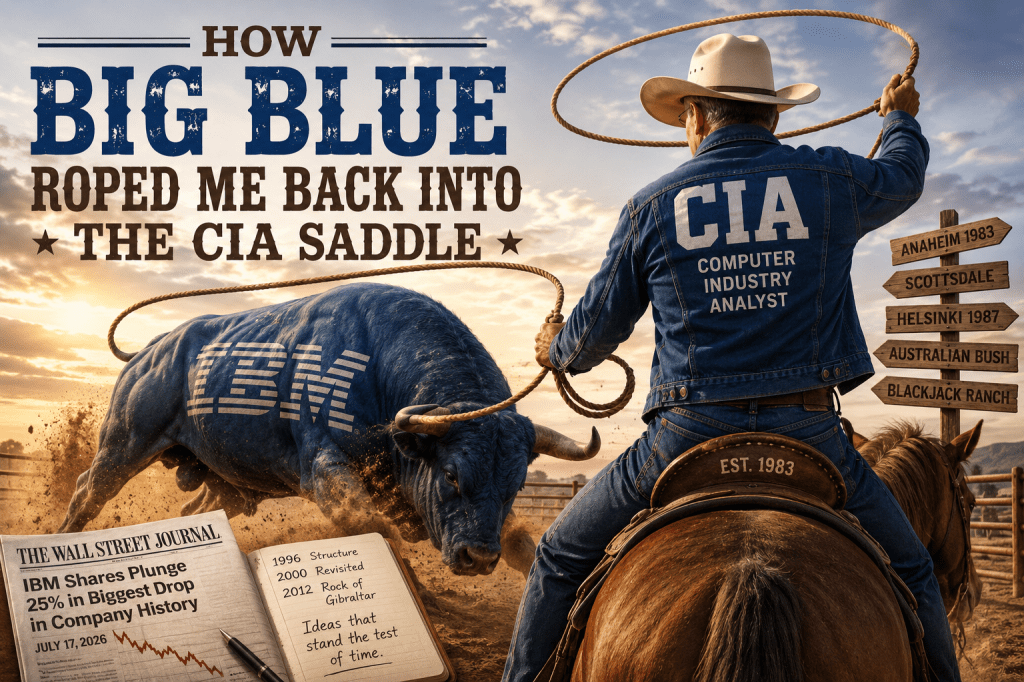
Just when I thought I had finally retired from analyzing the computer industry, IBM had other ideas.
On the morning of July 17, 2026, a Wall Street Journal headline leaped off my screen.
“The stock plunged 25%, the worst day in the century-old company’s history.”
Big Blue had stumbled again.
The article described a company struggling with the realities of the AI era and, remarkably, executives questioning whether IBM had become too dependent on a relatively small number of large enterprise customers. They were now discussing ways to diversify toward midsize businesses.
As I read on, I had the strangest feeling.
I had been here before.
Not five years ago.
Not ten.
Thirty.
Back in March 1996, I published a report whose title left little room for ambiguity:
My argument wasn’t that IBM was a bad company. Quite the opposite. It was that its very size had become its greatest handicap. I believed that spinning off and selling off certain businesses would unlock tens of billions of dollars in shareholder value while creating faster, more focused companies.
IBM’s leadership didn’t exactly embrace the idea.
Nor did Wall Street.
Five years later, I revisited the thesis.
Special: IBM Breakup – Revisited Five Years Later? (Nov 2000)
Another dozen years after that, I wrote Big Blue Feet of Clay, arguing that IBM remained as solid as the Rock of Gibraltar—but also as immovable.


Today, reading the Wall Street Journal, I realized something.
The vocabulary had changed.
The problem had not.
From there I’d transition into the personal part:
The story also reminded me of something else.
People often described me as a financial analyst.
I never was.
I called myself a CIA.
A Computer Industry Analyst.
The acronym came to me at a computer industry show in Anaheim, California, in May 1983.
The amusing part was that I wasn’t one yet.
At the time, I was still “just” publishing the Annex Computer Report (ACR).
A month later, I sold our Toronto home and moved the family to Arizona.
ACR evolved into the Annex Bulletin, then into the Comprehensive Market Service (CMS), and before long I found myself doing something that didn’t fit neatly into anyone’s organizational chart.
IBM never quite knew where to put me.
Was I a consultant?
A financial analyst?
A media influencer?
The answer was…
Yes.
Some ideas take thirty years to catch up with reality.
Especially if you are a Big Blue Giant with a matching bureaucracy.
CODA 1: IBM and the Vatican
Over breakfast I tried to explain the IBM story to my wife.
She listened patiently, then shrugged.
“I don’t see what the big deal is. Breaking up a company into smaller ones sounds obvious.”
I smiled.
“Imagine someone proposing that the Vatican should split itself into five or six independent churches.”
She stared at me.
“That would be sacrilege.”
“Exactly.”
“Well,” I said, “that’s more or less how IBM—and much of Wall Street—reacted when I suggested breaking up Big Blue in 1996.”
She burst out laughing.
CODA 2: FOUR MISSED TURNS
As I reflected on this unexpected reunion with Big Blue, another thought occurred to me.
Perhaps the Wall Street Journal story wasn’t really about a bad quarter or a disappointing earnings report.
Perhaps it was about something much larger.
When I left IBM in 1978, one of the disagreements concerned what would soon become known as the personal computer. I believed the industry was about to change in ways that seemed obvious to me but not to many inside the company.
Three years later, IBM entered the PC business. But instead of defining the new era, it eventually became one of its followers.
The 1990s brought the Internet revolution. Once again, IBM possessed extraordinary technical talent and resources. Yet it approached the Internet largely as an extension of its existing enterprise business rather than as a force that would reshape the entire industry. That was one of the reasons I argued in 1996 that the company should be broken up into smaller, faster-moving businesses.
Then came the Cloud.
IBM participated.
Others led.
Now comes Artificial Intelligence.
Once again, IBM has world-class technology, brilliant scientists, and decades of research. Yet the leadership of another industry transformation appears to be taking shape elsewhere.
Four major turns.
The Personal Computer.
Source: Annex Research
The Internet.
The Cloud.
Artificial Intelligence.
IBM was present at every one of them.
Yet somehow it missed every turn.
Perhaps that is the burden of being a giant.
Large organizations are exceptionally good at refining the present.
History, however, rewards those willing to reinvent the future.


Leave a Reply