

Economic plutocracy and the growing vulnerability of our digital civilization
Reform or Revolution?
By Bob Djurdjevic – November 17, 2026
Thirty years ago, I took the chairman of IBM to task for his obsession with corporate centralization. I called him Louis XIX of Armonk.
Today, Armonk is no longer the principal problem. An entire industry has embraced the philosophy I challenged in 1996.


The corporate kingdoms have become digital empires. Their subjects are no longer merely employees and shareholders. They are billions of people whose daily lives depend on the technological infrastructure these empires control.
And what happens when one of these empires falters?
We all feel the tremors.

1. Leopold Kohr: The original prophet of bigness as problem
In 1957, the Austrian economist and political philosopher Leopold Kohr published The Breakdown of Nations. His thesis was as simple as it was revolutionary: excessive size is itself a source of social, economic and political problems.

Kohr challenged the conventional wisdom that bigger was necessarily better. He saw the concentration of power as an underlying cause of many of civilization’s troubles.
Nearly seventy years later, the computer industry is providing a technological illustration of his philosophy.
We have created machines of extraordinary intelligence and networks of unprecedented reach. Yet we have simultaneously created an economic structure in which the failure of a single corporation, a single computer system or even a single software update can disrupt the lives of millions.
The cure has become the poison.
2. My encounter with American antitrust law
My interest in economic concentration is not merely philosophical. It is rooted in my professional experience.
Between 1982 and 1984, as an independent computer industry analyst, I studied American antitrust law and spent time in the office of Judge David Edelstein, who had presided over the landmark United States v. IBM antitrust case.
The government had initiated the case in January 1969. Thirteen years later, in January 1982, it abandoned it.
Thirteen years!
- Discovery Paperwork. Pretrial discovery produced roughly 30 million pages of documents exchanged between the Department of Justice and IBM.
- Trial Transcripts. The six-year trial (1975–1981) generated 104,400 pages of official court transcripts and testimony from nearly 1,000 witnesses.
- Additional Subpoenas. In 1979, a single government subpoena requested records estimated by IBM’s defense team to total 5 billion pieces of paper.
And all that – for naught. Because Ronald Reagan’s antitrust enforcer William Baxter pulled the plug.
Why?
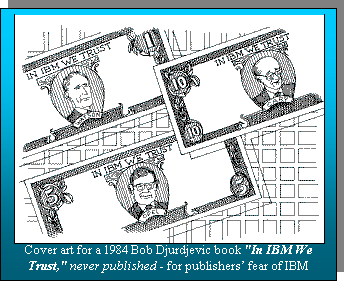
The answer to that lay in my unpublished 1984 book “In IBM We Trust.” And it was that IBM infiltrated and manipulated the government to subvert justice in its favor. Alas, no major American publisher (and especially not any minor ones) dared publish it. There is a chapter about that in my just-released book BEING DAVID.
In the computer industry, thirteen years can encompass several technological revolutions. Yet the American legal system had spent that much time trying to determine whether one corporation had illegally monopolized a market. Only to fail to render a verdict.
Even then, more than forty years ago, I was struck by the inadequacy of our antitrust laws in dealing with the dynamics of the computer industry.
A market share of approximately 70 percent was commonly regarded as evidence of monopoly power. But the possession of such power was not necessarily unlawful. The government generally also had to establish that the power had been acquired or maintained through anticompetitive conduct.
In other words, the law was primarily concerned with how a corporation had acquired and exercised its power, rather than whether the concentration of that power was itself dangerous.
That distinction is critical.
A corporation may have acquired its dominant position entirely legally. It may have developed superior products, employed brilliant people and served its customers exceptionally well.
Yet the resulting concentration of economic power can pose a danger to society.
3. Louis XIX of Armonk
By the 1990s, my concern about corporate centralization had become a recurring theme in my Annex Research editorials.
I advocated decentralization at EDS in 1992 and at IBM in 1996 and during the following years.
On August 22, 1996, following IBM’s consultants conference in Toronto, I published an editorial entitled Louis XIX of Armonk.
IBM chairman Louis Gerstner had declared:
“The PC revolution was driven by individuals. Network computing is about… enterprises.”
I disagreed.
As I wrote at the time:
“The PC and the Internet have empowered individuals and small companies to compete with giant enterprises on a level playing field. They’ve become equalizers.”
The personal computer and the Internet were instruments of economic democratization. They offered individuals and small enterprises opportunities that had previously been the exclusive domain of corporate giants.
Yet Gerstner’s vision was enterprise-centric. And his chief strategist, Bruce Harreld, revealed something even more illuminating about IBM’s economic ambitions.
In defending Gerstner’s insistence on keeping IBM’s businesses integrated, Harreld told me:
“Wait till we get to a 60% market share.”
My published response was:
“Wonder what the Justice Dept.’s antitrust lawyers would say about this if IBM were one day to corner the services market?”
The issue was not simply the supposed technological advantages of integration. It was economic power — buying power, pricing power and market dominance.
There was another danger inherent in such concentration: the suppression of independent thinking.
When I challenged a panel of IBM executives to express disagreement with their chairman, I told them:
“I realize that voicing them may be career-threatening. But not to, may be IBM-threatening.”
My argument was that a decentralized IBM would not require a hands-on CEO-king in Armonk. It would have several independent enterprises, each with its own leadership, strategy and accountability.
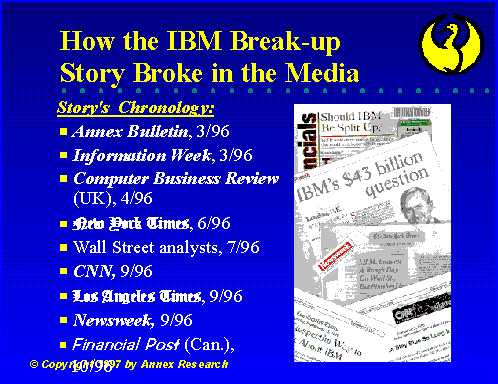
I called them “Baby Blues” in my March 1996 article “Break Up IBM!”
Who would COMPETE with one another.
| IBM in 1996 | Existing | Proposed restructuring |
|---|---|---|
| Revenue | $72 billion | $46 billion |
| Market value | $60 billion | $103 billion |
| Share price | $106 | $180+ |
To the benefit of shareholders. But that would also mean less power for the king. In fact, no need for just one king.
Hence Louis XIX of Armonk.
4. The revolution that created a new economic plutocracy
Thirty years later, the historical record presents us with a fascinating paradox.
The personal computer and the Internet did empower individuals and small businesses, as I had predicted.
What I underestimated was the ability of large corporations to appropriate the instruments of decentralization and use them to establish new concentrations of economic power.
Some of the old corporate dinosaurs survived. Others were replaced by new ones.
The Internet democratized access to information while enabling the concentration of economic power.
It decentralized computing while centralizing ownership.
The corporate giants of the digital age may operate millions of computers scattered across the globe. But the ownership and economic control of those computers are concentrated in relatively few hands.
Physically distributed. Economically centralized. Systemically vulnerable.
That is what I call economic plutocracy.
5. When bigger stops being smarter
On October 2, 2026, I published an editorial entitled When Bigger Stops Being Smarter.

Drawing upon Kohr’s philosophy, I examined the limitations of technological bigness, particularly in the age of artificial intelligence.
We had spent decades escaping the limitations of centralized computing, only to reinvent it on an astronomical scale.
But there is another dimension to this problem, beyond the economic and computational limitations of bigness.
Vulnerability.
We have not merely reinvented the mainframe. We have reinvented its vulnerabilities on a planetary scale.
6. The cure becomes the poison
Consider the worldwide cloud infrastructure services market.
According to Synergy Research Group, global enterprise spending on these services reached approximately $168 billion in the third quarter of 2026, up 55 percent from a year earlier.
Three American corporations accounted for 61 percent of that market:
- Amazon — 26 percent
- Microsoft — 19 percent
- Google — 16 percent
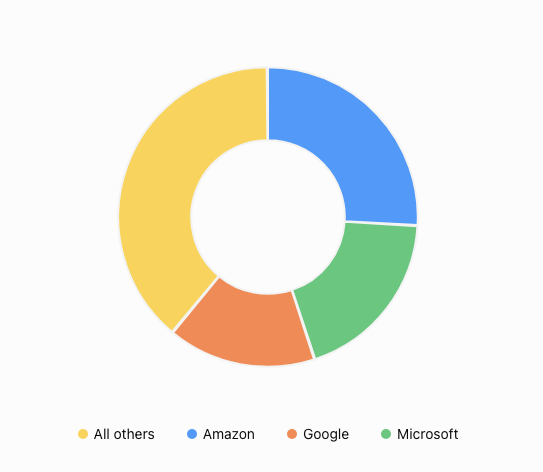
Three corporations. Nearly two-thirds of a worldwide market that is becoming increasingly indispensable to modern civilization.
And cloud computing is only one example. Similar questions arise in operating systems, Internet search, digital advertising, mobile application distribution and other sectors of the digital economy.
The benefits of large-scale computing are real. But so are the corresponding risks.
Economies of scale can become failures on a massive scale. Automatic software updates can automatically propagate errors. Centralized security can create exceptionally attractive targets for hackers. Standardization can produce technological monocultures. Outsourcing can become a surrender of local control.
The very characteristics that make centralized systems economically attractive can also make them systemically dangerous.
The cure becomes the poison.
| The cure | The poison |
| Centralized computing | Concentrated risk |
| Economies of scale | Failures on a massive scale |
| Automatic software updates | Automatic propagation of errors |
| Universal connectivity | Universal exposure |
| Centralized security | High-value targets for hackers |
| Standardization | Loss of technological diversity |
| Outsourcing IT management | Loss of local control |
7. The tremors are already being felt
One need not look far for evidence of the growing vulnerability of our digital civilization.
Consider what has happened in just six days — November 12–17, 2026.
November 12 — Microsoft. A worldwide breakdown disrupted Outlook, Teams, Copilot and other Microsoft 365 services across more than 70 countries. Governments, businesses and financial institutions struggled to function. Some financial firms resorted to fax machines to confirm transactions. Downdetector recorded more than 7.4 million problem reports. The disruption lasted more than 24 hours.
Ironically, organizations that had retained their own servers were partly spared. So much for the supposed superiority of centralized cloud computing.
November 13 — Federal Aviation Administration (FAA). A communications network failure forced a nationwide ground stop, disrupting thousands of flights across the United States. The installation of a router during a routine telecommunications upgrade was identified as the source of the problem.
One router. An entire nation’s air transportation system disrupted.
November 13–14 — Workday. A disaster-recovery test disrupted the company’s production systems, affecting customers dependent on its payroll, personnel and financial management software.
A system designed to protect against disasters had itself become the source of one.
November 15 — Amazon Web Services (AWS). Authentication and connectivity problems affected eleven services in Amazon’s Northern Virginia cloud region.
November 16 — American banking system. A software malfunction at JPMorgan Chase disrupted transactions and affected customers of several other major financial institutions, including Bank of America, Wells Fargo, U.S. Bank, Capital One and Truist. The Zelle electronic payment network was also affected.
One bank’s computer problem became other banks’ customers’ problem.
November 16 — United Airlines. A widespread technology failure delayed departures for more than 90 minutes. The airline’s aircraft weight and balance system was reportedly at the heart of the problem.
November 16–17 — BBC, CNN, Fox News, Zoom, Salesforce, HSBC, Equifax, IKEA, Air France and KLM. A cyberattack exploiting a vulnerability in a shared software supplier, Optimizely, exposed websites belonging to at least 178 organizations to malicious code.
The malware was designed to steal payment information, divert cryptocurrency transactions and exploit vulnerabilities in Apple iPhones and iPads.
The hackers did not need to penetrate 178 independent organizations. They exploited a vulnerability in one supplier upon which those organizations depended.
November 17 — National Security Agency (NSA). Even America’s highly classified intelligence communications network was not immune. CNN reported a disruption of NSA Net, the agency’s internal classified communications system. The precise cause had not been publicly established.
November 17 — Apple. An internal software update disrupted Apple Music, the App Store, AppleCare and iCloud authentication. Users also reported problems with Apple Pay and the activation of new iPhones.
The company that has made technological integration one of its principal selling points was demonstrating its downside.
November 17 — Marriott International. A technical malfunction prevented customers from signing into the hotel giant’s website and Bonvoy application.
All of the above in just SIX DAYS!
Banking. Air transportation. Government. National security. Telecommunications. News media. Retailing. Hospitality. Personal computing.
Virtually every major aspect of modern civilization is becoming dependent upon interconnected digital systems.
And here is perhaps the most disturbing aspect of these developments.
With the notable exception of the Optimizely attack, most of these failures have not been attributed to malicious activity. Nor has a common cause been established.
An increasingly centralized digital civilization does not even require an enemy to bring parts of itself to a standstill. It is quite capable of doing so on its own.
A defective software update. A malfunctioning router. A programming error. A failed disaster-recovery test. A routine installation of a new router at a remote radio communications facility in Arkansas triggered a chain reaction that brought American air transportation to a standstill.
Today’s Reuters report puts the subsequent number of flight cancellations at more than 18,000.
Ordinary technological mishaps with extraordinary societal consequences.
These incidents illustrate how technological dependence can magnify the consequences of individual failures far beyond their points of origin.
And who pays the price?
Not the CEOs of large companies. Not just the shareholders of the corporations responsible for the failures. Millions of innocent customers, travelers, businesses and taxpayers.
Privatization of profits. Socialization of risks.
Nature understood the importance of diversity long before economists and computer scientists arrived on the scene.
Biodiversity makes ecosystems resilient. Monocultures make them vulnerable to disease.
Why should the digital ecosystem be any different?
8. So what is the solution?
The solution is not to abandon the extraordinary technological achievements of the last three decades.
It is to liberate them from excessive concentrations of economic power.
And that requires political and legal action.
The principal American antitrust statutes — the Sherman Act of 1890 and the Clayton Act of 1914 — were enacted long before the computer industry existed.
Their underlying principles remain valuable. But their application must be adapted to the realities of the twenty-first century.
We need a new antitrust doctrine that recognizes excessive concentration of economic power as a potential danger in itself.
Instead of waiting until a corporation has achieved overwhelming dominance and then spending years trying to prove that it has abused that dominance, we should prevent dangerous concentrations of power from developing in the first place.
The historical 70 percent benchmark is far too high for markets upon which the functioning of an entire society may depend.
New legislation should establish considerably lower thresholds, appropriate to the characteristics and systemic importance of individual markets.
At predetermined levels of concentration, restrictions on acquisitions and expansion should become mandatory. Beyond those levels, structural separation and divestiture should be required.
Not requested. Not negotiated indefinitely.
Required by law.
Such legislation should also address oligopolies. A market dominated by three corporations can be dangerously concentrated even if none individually possesses a majority market share.
And the resulting enterprises must be genuinely independent, not merely subsidiaries of the same corporate parent.
This is not an argument against capitalism.
It is an argument for competitive capitalism, as opposed to economic plutocracy.
Nor must corporate breakups necessarily destroy shareholder wealth. Shareholders can receive ownership in the independent enterprises created through divestiture. And often times earn a lot MORE from the new enterprises than from a mega parent.
We would not be punishing corporate success. We would be preventing corporate success from becoming a danger to society.
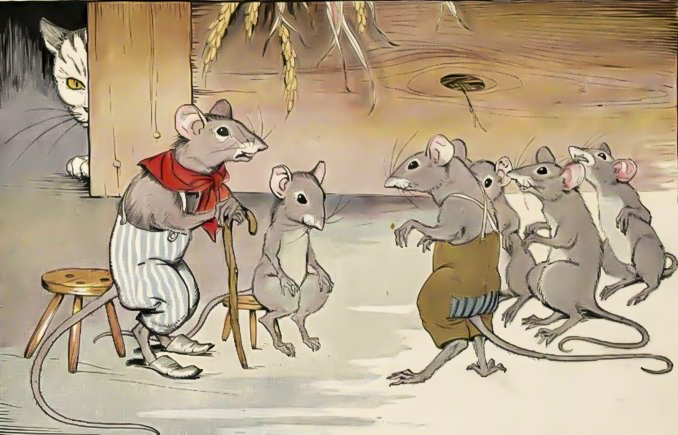
9. Who will bell the cat?
There is, of course, an enormous political obstacle to such a solution.
The corporations whose economic power needs to be curtailed possess considerable influence over the politicians responsible for curtailing it.
Through lobbying, campaign financing and the revolving door between government and industry, concentrated economic power can be translated into political influence.
Economic plutocracy can thus become self-perpetuating.
Expecting the beneficiaries of such a system to dismantle it voluntarily would be whistling Dixie.
But if the institutions of representative government prove incapable of implementing peaceful structural reforms, what alternatives remain?
History provides some uncomfortable answers.
10. Reform or revolution?
Thirty years ago, I warned IBM’s Louis XIX of Armonk about the fate of the former residents of Versailles.
Today, that warning applies to an entire economic order.
We have a choice. We can decentralize economic power through legislation, judicial action and orderly corporate restructuring. Or we can allow the concentration of power to continue until the pressures for change overwhelm the institutions designed to manage them.
History offers ample evidence of what can happen when peaceful avenues for reform are closed.
Revolutions always change the established order. They do not necessarily change it for the better.
That is precisely why peaceful reform is preferable.
Revolutions are rarely the preferred instruments of change. They are often the consequences of a refusal to change.
Nearly seventy years after Leopold Kohr published The Breakdown of Nations, we are confronting the same fundamental question in a different technological setting.
How much power is too much power?
The objective should not be smaller technology. It should be smaller concentrations of power.
The democratization of computing must be accompanied by the democratization of economic power.
The choice is between reforming the system and risking its breakdown.


Leave a Reply