

🎼The Case of the Morphing Melody That Tied Two Great Composers – Mozart and Beethoven – via London and Maui
By Bob Djurdjevic, September 21, 2025
A True Musical Mystery
It began, of all places, at the Royal Albert Hall in London. The concert was magnificent — a program I later dubbed The Three R’s: Rimsky-Korsakov, Rossini, and Rachmaninoff. My ears were full, my soul uplifted, but that wasn’t the music that stayed with me.

No — it was something else. A melody that appeared out of nowhere. Serene yet powerful. Soft-spoken, yet insistent. Like someone whispering from a dream I’d once had but forgotten.
It followed me back to Maui.
A Tune That Wouldn’t Let Go
Back home, I had no Clavinova, only my Steinway. So I sat at the keys, let my fingers wander, and played what I heard in my head. The melody poured out, fragile and pure. I heard it as a violin, though I couldn’t explain why. I played it again and again — not from sheet music, but from memory. Or was it instinct?
Eventually, after a bit of musical sleuthing, I cracked the first clue:
It was Mozart’s Clarinet Concerto in A major, K.622 — Second Movement.
So why did I hear it as a violin?
Because this was only part of the mystery.
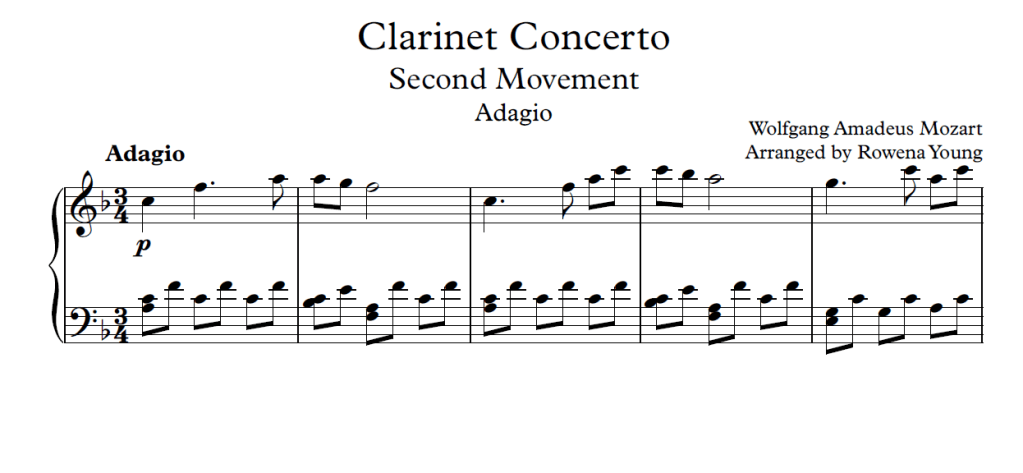
Enter: Beethoven
As I played the melody through, something strange occurred: it didn’t end where Mozart left it. My inner ear kept going. The theme morphed into something else — similar in spirit, seamless in style — yet unmistakably different. I didn’t notice the shift at first. It was that smooth. But when I isolated the second half, I realized: this wasn’t Mozart anymore.
The continuation turned out to be Beethoven’s Romance in F major, Op. 50 — written for violin.
(click on the sheet music below to listen)

Suddenly, I was facing not just a tune, but a timeline.
Had Beethoven — the young admirer, the rising star — heard Mozart’s clarinet concerto? Could he have borrowed its essence for his own violin piece? After all, in those days composers didn’t worry about copyright. They borrowed, adapted, and paid homage. Music was a language shared, not owned.
And this… this felt like a musical handshake across time.
Reconstruction by Ear
What made this even more personal was the fact that I had played the Mozart piece – entirely by ear. No sheet music. No analysis. Just emotional memory. I did confirm the key afterward (yes, I played Mozart in A major as written), but the rest came from inside me — or from somewhere beyond.
Years later, I recorded both on my Clavinova:
- 🎧 Mozart — soft, searching, like a clarinet with a violin’s soul.
🎧 Beethoven — swelling into an orchestral soundscape, complete with horns not found in the original score, but conjured from imagination.
Where Does Music Live?
That question still haunts me. Is music stored in the brain? The fingers? The heart? The soul?
Maybe the answer came not from me, but from the man who closed this case:
“God speaks to us through music. And in my case, He is shouting in my ears.”
— Ludwig van Beethoven
Indeed.
Because sometimes, when you follow a melody long enough, it leads you not to a destination — but to something deeper.
It leads you to yourself.
 Truth in Media
Leave a comment