
MEET AN IMPOSTOR AND THREE REAL FATHERS OF THE INTERNET
Unlike human babies, whose conception is a matter of seconds but gestation and birth last usually nine months, scientific ideas take but a second to get conceived and years to actually get created. The now ubiquitous Internet is one such a baby. As close as anyone can pinpoint the exact delivery date, the Internet is celebrating its 30th birthday this year.
On April 30, 1993, something called the World Wide Web launched into the public domain (per NPR).
The World Wide Web and the HTML language was the brainchild of Tim Berners-Lee, a British researcher at a physics lab in Switzerland called CERN. The institution is best known today for its massive particle accelerators. CERN owned Berners-Lee’s invention, and the lab had the option to license out the World Wide Web for profit. But Berners-Lee believed that keeping the web as open as possible would help it grow.
And grow it did. By leaps and bounds, spawning human creativity and interconnection around the globe like no other invention in the history of mankind.
But that’s only one dimension of the internet – the software part. The physical network was first created by two American scientists – Vint Cerf and Bob Kahn. The Internet is fundamentally a collection of disparate networks – that’s why it’s called the internet. his required the introduction of TCP/IP, a communications protocol. Cerf and Kahn developed the protocol in the early 1970s. Kahn worked for ARPA – the U.S. Department of Defense agency that funded the ARPAnet – and Cerf was an assistant professor at Stanford University.

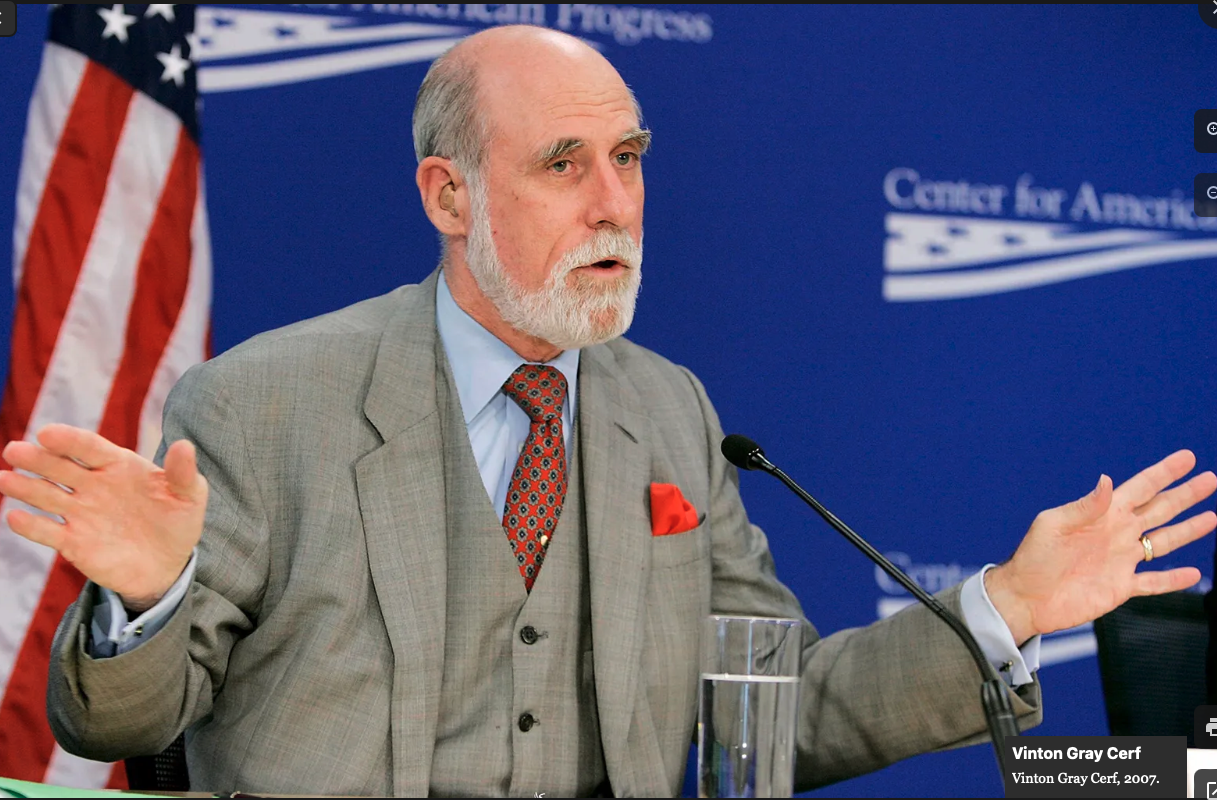



So it took the work of two Americans and one British scientists to create the baby Internet. And the most accepted launch date was 1993, as you saw above.

IMPOSTOR-CREATOR OF THE INTERNET
But hold your horses. Not so fast. At about the same time, in 1993, another man, very prominent at the time, claimed that he had created the internet.
From the October 26, 1993 issue of the New York Times:
“One of the technologies Vice President Al Gore is pushing is the information superhighway, which will link everyone at home or office to everything else—movies and television shows, shopping services, electronic mail and huge collections of data.”
In a March 9, 1999 interview with CNN’s Late Edition with Wolf Blitzer, Gore claimed among other things that he had created the internet:
“During my service in the United States Congress, I took the initiative in creating the Internet.”
“I took the initiative in creating the Internet” (Al Gore)
Well, maybe he did. In Congress. Where the only thing that gets created regularly is higher tax bills. But one thing Al Gore did become – a butt of jokes about his being the “father of the internet.”


In fact, were it for his rich family – father was a former Senator from Tennessee – it’s doubtful that Al Gore would have been successful on his own in creating anything worthwhile. But thanks to his family’s riches and connections he finished a private prep-school and got into Harvard. Here’s how he did there:
“Gore was an avid reader who fell in love with scientific and mathematical theories, but he did not do well in science classes and avoided taking math. During his first two years, his grades placed him in the lower one-fifth of his class. During his second year, he reportedly spent much of his time watching television, shooting pool and occasionally smoking marijuana.”
Wikipedia
Note the poor performance in science and math for this “Internet creator.”
After enlisting in the Army and doing a tour of soft duty in Vietnam as a journalist, Gore returned home and decided to become a lawyer. But he did not complete law school, deciding abruptly, in 1976, to run for a seat in the U.S. House of Representatives when he found out that his father’s former seat in the House was about to be vacated. He then stayed a politician the rest of his life, rising from a Congressman to a Senator, then Vice President, and finally unsuccessful presidential candidate.
But let’s not spoil this birthday bash by talking too much about a guy who did NOT create the Internet. The three men who did – Cerf, Kahn and Berners-Lee – should take another bow.
Of course, all three have received ample recognition in the last three decades. The Britton has been knighted in 2004 and is now Sir Tim Berners-Lee.
WHAT IS THE INTERNET?
Ask ten people this question and chances are you will get ten different answers. Because to most people the Internet is the applications they use – shopping, booking travel, paying bills, searching the news, watching games, movies, socializing with friends, etc.
Ask computer engineers, though, and they’ll tell you that the Internet is “the global system of interconnected computer networks that uses the Internet protocol suite (TCP/IP) to communicate between networks and devices.”
So the Internet is the network of networks – in computer jargon.
As of October 2023, the Internet had 5.3 billion users around the world, according to Statista. That’s 2/3 of the world population. In developed countries, however, that figure has reached 90%.

So the access to the Internet is reaching saturation at least in developed countries. But the variety of uses and the creativity it has spawned is limitless. That’s what this writer predicted nearly 30 years ago – in the first year of Internet baby’s life:

“The leading economies of the 21st century will not be industrial. They will be an information-driven mixture of arts and sciences. By the way, that’s a blend which a 16th century great (Western) mind also possessed. If a TV reporter stuck a microphone in front of Leonardo da Vinci, and asked him to separate his “art” from his “science”- he would probably have trouble doing it!
It’s the industrial era’s penchant for compartmentalizing things so as to be able to mechanize them that has driven us to differentiate between the two. Artists lived in a world which could not be mechanized. Until now, that is. With the advent of information technology, the (re)fusion of arts and sciences is also inevitable. In a way, man will be returning to nature courtesy of the silicon.
Another frightful thought, isn’t it?
Don’t worry. The universe is unfolding as it should…
Annex Bulletin, Nov 1994 Right image: Leonardo da Vinci, 1505 self-portrait
And now we know that the universe has been indeed “unfolding as it should” in the last 30 years.
======
Also see my column in the FORBES magazine, July 1997:
Move Over Einstein, Signor Da Vinci Is Back
http://www.djurdjevic.com/Columns/forbes7-97.htm
Update Dec 25, 2023
JOBS LOST, JOBS GAINED – THANKS TO THE INTERNET
As with any revolution, there is inevitable displacement of people and jobs. The Internet era has produced many new jobs, particularly in the fields which required creativity (IT, entertainment, professional services etc.). But in its wake, the Internet wave has also washed out a number of jobs.
When was the last time you walked into a travel agent’s office to book a trip? When was the last time you used a phone book to find something? BTW – when was the last time you saw a phone book? When was the last time you paid something with cash? (particularly if it is a sizable transaction).
Of course, some of these tectonic changes in the employment had been going on for much longer than the Internet has been around. Take a look at this chart from a Nov 2017 McKinsey & Company study.

As you can see, the resource-based industries – agriculture, manufacturing, mining – have been shrinking quite severely ever since computers entered the scene in a big way – roughly since the early 1970s. They have continued to diminish during the Internet era as well.
On the other hand, the biggest growth in new jobs has been in the trade (12.8%), education (9.9%), healthcare (9.3%), business and repair services (6.2%) and financial services (5.9%).
What do all these activities have in common? They are all SERVICES. There is no physical product they are creating.
That’s also a trend that this writer had been talking about since the 1980s (see The Upsizing of America (U.S. Jobs ’97).
In this 1998 article, for example, I pointed out that while the industrials have been shedding millions of jobs in the 1980s and the 1990s, the economy was actually growing from the bottom of the enterprise pyramid. As a result, the services accounted for nearly 3/4 of the US jobs in 1996.


Back to today’s global economy, McKinsey estimates that 250 million to 280 million new jobs could be created from the impact of rising incomes on consumer goods alone, with up to an additional 50 million to 85 million jobs generated from higher health and education spending.
Also, by 2030, according to McKinsey, there will be at least 300 million more people aged 65 years and older than there were in 2014. This will create significant new demand for a range of occupations, including doctors, nurses, and health technicians but also home-health aides, personal-care aides, and nursing assistants in many countries. Globally, McKinsey estimate that healthcare and related jobs from aging could grow by 50 million to 85 million by 2030.
Jobs related to new technologies will also grow. Overall spending on technology could increase by more than 50 percent between 2015 and 2030, according to McKinsey. About half would be on information-technology services. The number of people employed in these occupations is small compared to those in healthcare or construction, but they are high-wage occupations. By 2030, we estimate that this trend could create 20 million to 50 million jobs globally.
In short, you lose some, you win some. The future looks bright for those who are willing to embrace the change. For those who do not, well, they will left in the dustbin of history as millions of the now long departed humans had ended up.
 Truth in Media
Leave a comment